
- Solutions
- Partnerships
- Services
- Company
To get the most our of #!% please visit us from one of the following browsers.







 Resources
Case Study
Resources
Case Study
A specialty insurance provider modernized its reporting and analytics by replacing fragmented, consultant-dependent processes with a centralized Azure data platform and automated BI framework. The transformation delivered real-time insights, unified reporting, and significant operational efficiency across underwriting, claims, and financial functions.
The insurer operates across multiple regions with a diverse coverage portfolio spanning property, liability, construction, hospitality, and professional lines, primarily distributed through broker networks.
However, their reporting landscape lacked consistency. Data was scattered across Salesforce, Microsoft GP, and other systems, forcing teams to manually consolidate information for even basic analysis.
Reports were slow to produce, difficult to validate, and often required external consultants to interpret or extract insights. As a result, business leaders lacked timely visibility into performance metrics, underwriting trends, and operational health-impacting agility in a competitive market.
To overcome these limitations, the insurer partnered with GainInsights to build a unified, automated reporting foundation on Microsoft Azure.
The first step was integrating Salesforce, Dynamics GP, and other operational sources into a centralized data repository. This single source of truth eliminated inconsistent views and simplified analysis across teams.
Power BI dashboards were then introduced to enable self-service reporting. Underwriting, claims, and finance teams could now access validated KPIs through interactive visualizations, reducing reliance on external specialists and enabling faster, clearer decision-making.
To ensure reliability and accuracy, the solution included automated ETL pipelines built with Azure Data Factory and Azure Data Lake. These workflows handled extraction, transformation, loading, and data quality checks with minimal manual intervention
.
Daily refresh cycles ensured that internal teams always worked with complete, up-to-date information. A strong governance layer: covering access controls, credential management, and error-handling; reinforced compliance and supported the insurer’s readiness for future expansion.
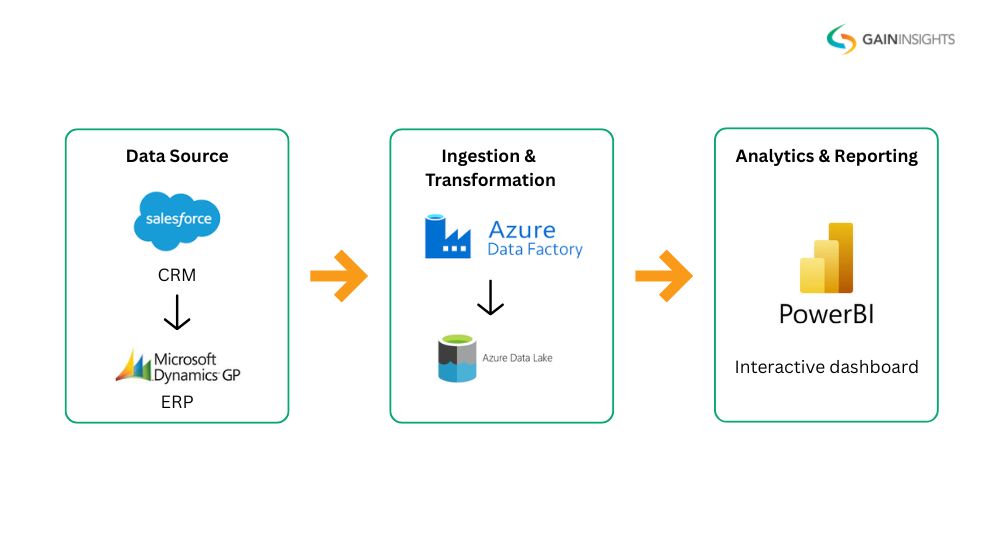
The solution was powered by a robust, scalable cloud architecture:
This foundation not only addressed current reporting challenges but also positioned the organization for advanced analytics and future data initiatives.
With unified data and automated reporting, teams gained consistent and reliable performance metrics across underwriting, claims, and financial operations. External consultant dependency dropped, internal teams became more self-sufficient, and reporting cycles moved from slow, manual processes to fast, automated workflows.
This shift empowered employees to focus on strategic analysis such as risk trends, portfolio performance, and operational optimization; instead of time-consuming data handling.
The BI modernization initiative delivered strong quantifiable and qualitative benefits:
By centralizing data, automating ETL pipelines, and implementing Power BI dashboards, the specialty insurer shifted from fragmented reporting to a streamlined, scalable, and fully governed analytics environment.
The organization now operates with real-time visibility, improved productivity, and stronger decision-making capabilities: setting the stage for continued growth and innovation in the insurance sector.

