






Use this reference article and the example scenarios to help you understand the impact of Microsoft Fabric’s July 2025 update — Direct Lake Semantic Models.
Context
With its latest Direct Lake Semantic Models update, Microsoft Fabric promises what Power BI users have long awaited: “Truly Real-Time Analytics” now supported in Desktop.
Previously, the “native” approach (Import, DirectQuery, or legacy streaming) offered only near real-time experiences, often relying on scheduled refreshes, pushed datasets, or limited direct queries, which introduced lag and performance tradeoffs.
Let’s discuss the key takeaways, architecture overview, TCO & ROI, setup requirements, the reasons companies choose to adopt Direct Lake, and our concluding insights.
Key Takeaways on Direct Lake Semantic Model
In the following sections, we’ll briefly explore:
Takeaway 1: Direct Lake delivers real-time analytics by instantly reflecting changes from Delta tables in OneLake, eliminating the lag, scheduled refreshes, and query bottlenecks of conventional fast-refresh approaches.
Direct Lake mode in Microsoft Fabric connects semantic models directly to Delta tables in OneLake, instantly reflecting data changes and bypassing heavy scheduled refreshes typical of Import mode or DirectQuery. The “Keep your Direct Lake data up to date” feature ensures changes are propagated near-instantly, closing the gap between event and insight.
Case: Real-Time Retail Inventory Analytics
A leading retailer integrated their e-commerce, POS, and logistics feeds into Fabric’s Lakehouse. Using Direct Lake Semantic Models, inventory and sales dashboards now update in real time, giving its:
Previously, near real-time approaches left teams waiting 15–60 minutes for uploads and refreshes; now, they respond instantly, reducing out-of-stocks and increasing promo conversions.
Takeaway 2: Direct Lake will continue to deliver high performance at scale, even as data volumes and user concurrency grow without introducing bottlenecks or unpredictable costs.
Direct Lake’s architecture is built to handle enterprise-scale data, supporting millions to billions of rows with high user concurrency. As only query-relevant data loads into memory, performance remains consistent even with rapid growth. Pricing is capacity-based, letting you compute as needed and control costs proactively.
Case: Scalable Analytics for a Global Manufacturer
A worldwide manufacturer expanded their analytics platform from a single plant to multiple facilities distributed globally. Using Direct Lake Semantic Models, they maintained high-performance, responsive dashboards despite rapidly increasing data volumes and user concurrency, enabling:
Prior to Fabric, their solutions struggled with latency and higher costs as scale increased. Direct Lake’s flexible capacity-based pricing and query-efficient architecture ensured consistent performance and predictable expenses, supporting growth without disruption.
Takeaway 3: Direct Lake aligns seamlessly with existing tech stacks and governance frameworks, ensuring secure and consistent access to insights.
Direct Lake integrates natively with Power BI and Fabric, using workspace roles and SQL analytics endpoint permissions, with no need for redesign of governance. Delta tables in OneLake support central metrics, business logic, and security rules, delivering single-source-of-truth insights and audit-ready access management.
Case: Seamless Integration and Governance in Financial Services
A leading financial services company adopted Direct Lake Semantic Models to unify analytics across departments while adhering to strict compliance requirements. The integration delivered:
Previously, fragmented systems created governance challenges and risked inconsistent, conflicting insights. Direct Lake’s native integration with Power BI and OneLake enabled a single source of truth with robust security, simplifying adherence to regulatory mandates.
How it Works
Let’s take a look at the Direct Lake design, why investing in it makes a difference.
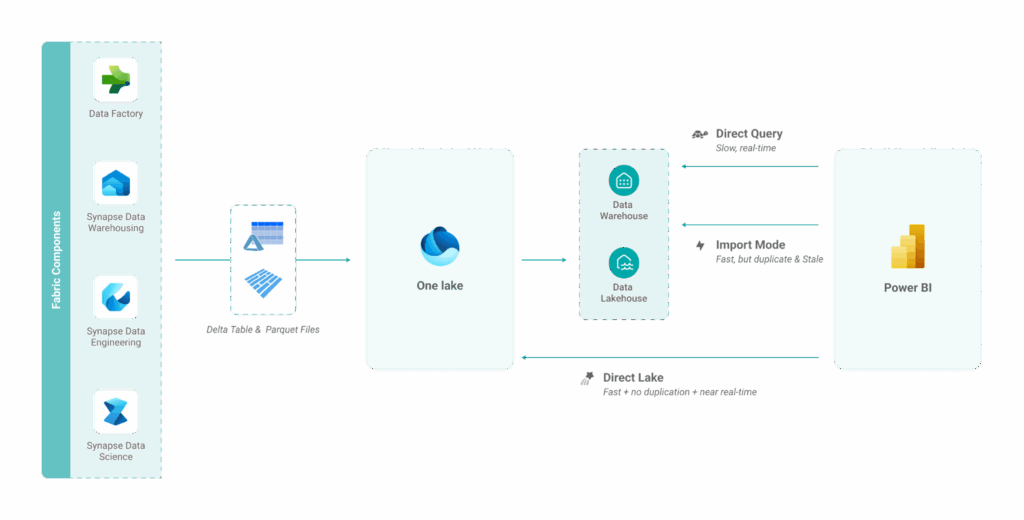
The above-architecture helps support alignment with industry standards and internal governance policies, enabling consistent reporting and audit-ready data access across teams.
Direct Lake isn’t just another connector, it’s a shift in how analytics are delivered. Businesses choose it because:
1. Instant, Scalable Insights: Delivers up-to-the-second analytics across massive datasets—a real advantage for industries where speed is essential.
2. Centralized Metrics & Consistency: Business logic and metrics are defined in one place, ensuring every team works from the same version of the truth.
3. Efficient Scaling: Only the needed data is loaded, so reporting remains responsive even as your data grows.
4. Future-Ready Foundation: The architecture easily supports advanced analytics and upcoming AI/ML features, making your data investments ready for what’s next.
TCO & ROI: What’s the Real Financial Upside?
Investments in Direct Lake can offer impressive pay offs for data-driven enterprises looking for scale.
What’s Involved to Get Started – Setup Requirements
Having understood what it means to keep the Data Lake at the heart of your architecture, let’s explore what’s needed to prepare while transitioning from current or legacy frameworks.
1. Store Your Data Properly: Ensure your tables are formatted as Delta in OneLake or Fabric Warehouse; this is critical for Direct Lake support.
2. Establish Access Controls: Set up workspace permissions so only authorized users can build and use models, aligning with existing security policies.
3. Model Creation: Use Power BI Desktop or Fabric’s browser interface to connect your semantic models directly to your lakehouse data; minimal manual effort if your tables are prepped.
4. Collaborate on Governance: Involve your data engineers early to ensure data is reliable, relationships are mapped, and governance is enforced for long-term maintenance.
Conclusion
With Microsoft Fabric’s Direct Lake Semantic Models, organizations can finally drive real-time, large-scale analytics with reduced complexity and costs. The resulting speed, reliability, and future-proof architecture deliver immediate value for today’s needs and tomorrow’s growth.
Share your favorite real-time analytics use case or how you see Microsoft Fabric fitting into your data strategy, whether for dashboards, enterprise reporting, or governance.
If you’d like to explore how Fabric can support your goals, contact us at info@gain-insights.com.