






Overview: Demand forecasting predicts future customer needs using historical data and AI. With Azure Machine Learning, businesses can build customized forecasts, adjust them as needed, and track accuracy through KPIs in Supply Chain Management.
This blog looks at how demand forecasting and dynamic pricing help businesses stay competitive and explains the architecture that makes real-time decisions possible.
Predict Future Demand for Products
In today’s fast-moving market, static pricing and slow forecasting leave businesses behind. Many still struggle with scattered data, outdated models, and siloed decisions.
Microsoft Fabric solves this with a unified data and AI platform, enabling businesses respond in real time to changing demand, competition, and customer behavior. Combining data engineering, AI, and real-time analytics, Fabric helps businesses move from manual planning to automated, predictive operations.
To say, retailers can adjust prices instantly as inventory shifts, and hospitality providers can react to sudden booking spikes on the spot. Fabric makes this level of agility possible today.
How the Fabric Solution Works
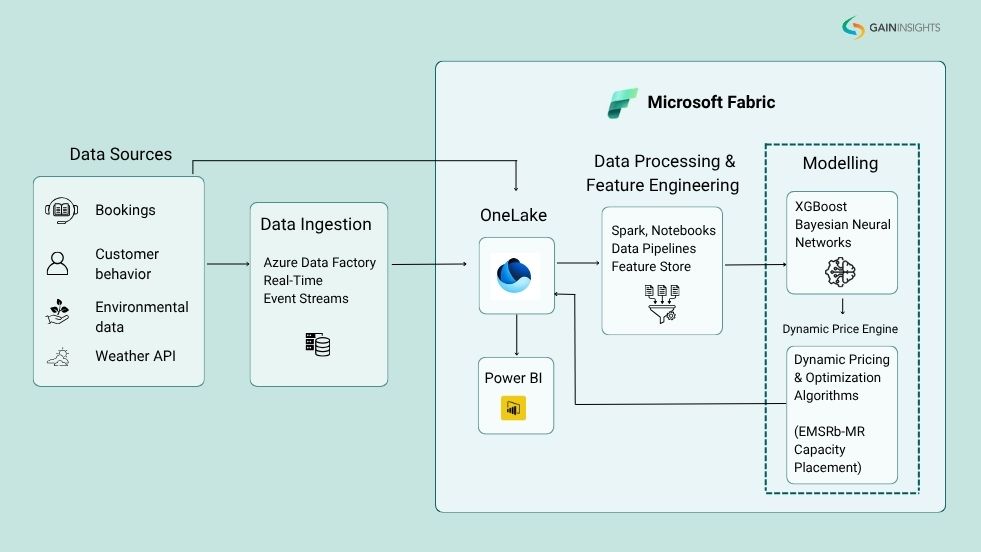
Instead of juggling multiple tools and fragmented systems, Fabric gives you one intelligent foundation for real-time pricing and forecasting. The architecture below shows how all components work together.
1. Centralize Everything with OneLake
Microsoft OneLake unifies data from diverse sources, from bookings and customer behavior to environmental inputs to historical demand into a single, consistent repository. This eliminates silos, ensures every team works from the same up-to-date information. It results in faster decision-making and a single source of truth that powers all downstream analytics.
2. Stream Data in Real Time
Data flows continuously into Fabric via Data Factory pipelines and Real-Time Eventstreams. It could be either live streaming data or periodic batch updates. This allows instant responses to triggers like weather, news, booking surges, or competitor pricing; enabling strategies to adjust in the moment.
3. Predict Demand & Customer Behavior with AI
Using Synapse Data Science and Spark notebooks, machine learning models (such as XGBoost for forecasting and Bayesian neural networks) forecast demand and segment customers, uncovering patterns in willingness-to-pay. This deep insight drives pricing strategies that are both competitive and profitable.
4. Adjust Prices with Intelligent Algorithms
The EMSRb-MR Expected Marginal Seat Revenue – Marginal Revenue) algorithm dynamically adjusts optimal prices in real time, considering demand, capacity, and customer behavior. This turns pricing from a reactive into a proactive revenue optimization engine.
5. Optimize Operations in Real Time
Fabric uses demand forecasts to automate inventory, storage, or transport planning. This reduces waste, aligns operational resources with real-world demand, and improves margins without compromising service quality.”
6. See It All in One Dashboard
Power BI dashboards bring real-time insights, forecasts, and pricing adjustments into a single view. Decision-makers across the teams from sales, operations, and finance get a shared, up-to-date picture, enabling coordinated and informed decisions.
Standout Factors
This combination of unified architecture, real-time response, and industry-ready models makes Fabric not just a technical solution, but a smart approach for businesses aiming to stay competitive and agile.
Industry-Specific Solutions
1. Manufacturing: Predict demand for parts and components to optimize production schedules and supplier orders.
2. eCommerce: Tailor offers and pricing in real time using browsing behavior, cart activity, and purchase urgency.
3. Logistics: Adjust delivery slot pricing and optimize routes dynamically based on capacity and current demand.
Future-Proofing Your Pricing Strategy with Fabric
As industries evolve, so do the ways businesses can use Fabric:
Fabric isn’t just addressing today’s pricing challenges; it’s building a foundation for the next decade of adaptive, intelligent business operations. By unifying data, AI, and analytics in real time, Fabric gives businesses a strategy that is both scalable and resilient. In short, it turns insights into action, helping organizations stay ahead in a rapidly changing market.
Working with pricing or forecasting data? We’d love to hear your experiences or help you experiment with Fabric. Drop us a line at info@gain-insights.com.